
Anxiety Counselling vs Coaching: What Works?


Here's the short answer: Counselling helps you understand your anxiety by talking it through. Coaching helps you change it by rewiring how your mind and body respond. For a lot of people, talking about the problem only gets them so far, because anxiety doesn't just live in your head. It lives in your body. So let's get into the honest difference between the two, and how to work out which one you actually need.
Key takeaways
- Counselling is mostly about understanding the problem. Coaching is about changing your response to it.
- Anxiety isn't only a mental health problem. It's physical, so talking alone rarely finishes the job.
- Counselling tends to be reactive. Coaching is proactive, you build the skills before anxiety hits.
- Neither is wrong. If talk therapy has only ever got you so far, that's usually the sign you need to change what your mind and body are doing, not just understand it.
Why talk therapy only gets you so far
One of the most common things I hear from the people I work with is that they tried talk therapy and it only got them so far.
A lot of people believe counselling or therapy is the best path for anxiety. That's what we're told, it's the mainstream approach. But after working with 300 clients in my coaching business, I can tell you that for a lot of them, talking about the problem only goes so far.
Talking helps you understand the issue. But anxiety isn't only about understanding it, because it lives in your body, not just your mind.
People think it's a mental health problem. If you've actually experienced anxiety, you know it's physical too. So talking about it doesn't finish the job.
You've got to rewire your mind and your body.
That's why coaching can be more effective than counselling. You're not just talking about it, you're changing your behaviours, changing your habits, and taking self-responsibility to rewire the mind and the body.
Let's go through the three big questions people have when they're deciding between coaching and counselling for anxiety.
Misconception 1: Anxiety is a chemical imbalance you medicate
The first belief is that anxiety is genetic, or a chemical imbalance that needs medication to fix. For the last 50 years, doctors and psychologists have prescribed SSRIs and anxiety medication for it.
In my experience, medication can take the edge off, but it tends to manage the symptom rather than resolve the root. It's a temporary relief.
You might handle the panic or overwhelm a bit better, or reduce the severity of an anxiety attack, but it can end up being a band-aid over the problem.
Roughly speaking, an SSRI raises your serotonin, so your brain registers less threat in your environment. That matters because anxiety is a fear-based experience. You feel anxious because some part of you is perceiving threat or danger.
Picture how that plays out. You're constantly on the go, rushing from one thing to the next, trying to control your time, trying to hold a business or a relationship together. Maybe your partner says you're here but not really here, because you're in your head.
Underneath it is this sense that everything needs to be in control, and if it's not, something feels wrong or threatening.
You don't even know how to slow down and feel calm, because you're so used to going, going, going. Medication can help you slow down, but again, it's temporary, and it's reactive.
Coaching works differently. When you learn meditation, journaling, or other nervous system regulation practices, you teach yourself how to slow down. You build the skills and the tools to actually be present in your life. It's a more natural approach, and a more proactive one.
Medication is often reactive, you're reacting to the anxiety, instead of proactively putting things in place to deal with it before it shows up.
Quick caveat: I'm not a doctor and this isn't medical advice. I'm not anti-medication, and if you're on it, don't change anything without your GP. I just believe in learning the tools so you're not relying on it forever.
Misconception 2: If you have anxiety, you're broken
The second belief is that if you have anxiety, something is wrong with you, that you're broken. So people only reach for solutions in reaction to it.
Take breathing. You've maybe been told by a therapist to try some breathing exercises, but you only try them once the anxiety has already hit. You go through your day fine, then something happens, you start to feel overwhelmed, and only then do you reach for the breathing. That's reacting to the anxiety and trying to fix it in the moment. That's generally how the counselling-style fixes get used too, reacting to the problem.
Coaching flips it. When I teach someone breathwork and meditation, I'm not teaching them to do it when they're already triggered, panicked or overwhelmed. I'm teaching them to do it at the start of the day, as risk mitigation.
You practise in the morning so you can find a calm baseline, find your breath, find presence, before you even need it.
You're proactively lowering your stress so that when anxiety does come up, you're far better positioned to handle it.
That beats the alternative, which is "I'll just deal with it when it hits."
Misconception 3: You should figure it out on your own
The third belief is that you have to do it all by yourself. A lot of people, especially men, think that if it's their mind, their overthinking, their anxiety, they need to figure it all out alone. I don't think that's the best way.
This is actually where counselling helps. Talking it out helps you understand the problem, and having a support network is far better than trying to white-knuckle it on your own. Plenty of people try to deal with everything themselves and then quietly spiral into anxiety and depression while nobody even knows.
So I'm not here to bash therapy. For a lot of people it's a healthy first step, to open up and start talking. If you don't know how to deal with these issues, talking to someone who does, and getting that support and accountability, is a smart move.
But you get that same support and accountability with coaching. It really comes down to what kind of support you feel you need.
Some people feel safer with a counsellor or psychologist who holds government-approved certification. Coaching, honestly, is more of the wild west, and there are a lot of coaches out there.
The difference is that most coaches have lived experience. They've usually dealt with these issues themselves.
That's the case for me. I've dealt with this stuff personally. I don't have a psychology degree or a university background in it. I hold a diploma in mindfulness-based cognitive therapy and a diploma in mindfulness meditation.
It's a different approach, but because I've lived it and now coached over 300 clients, I've built a system that gets results consistently, and it's a lot more proactive than reactive.
Coaching vs counselling: the real difference
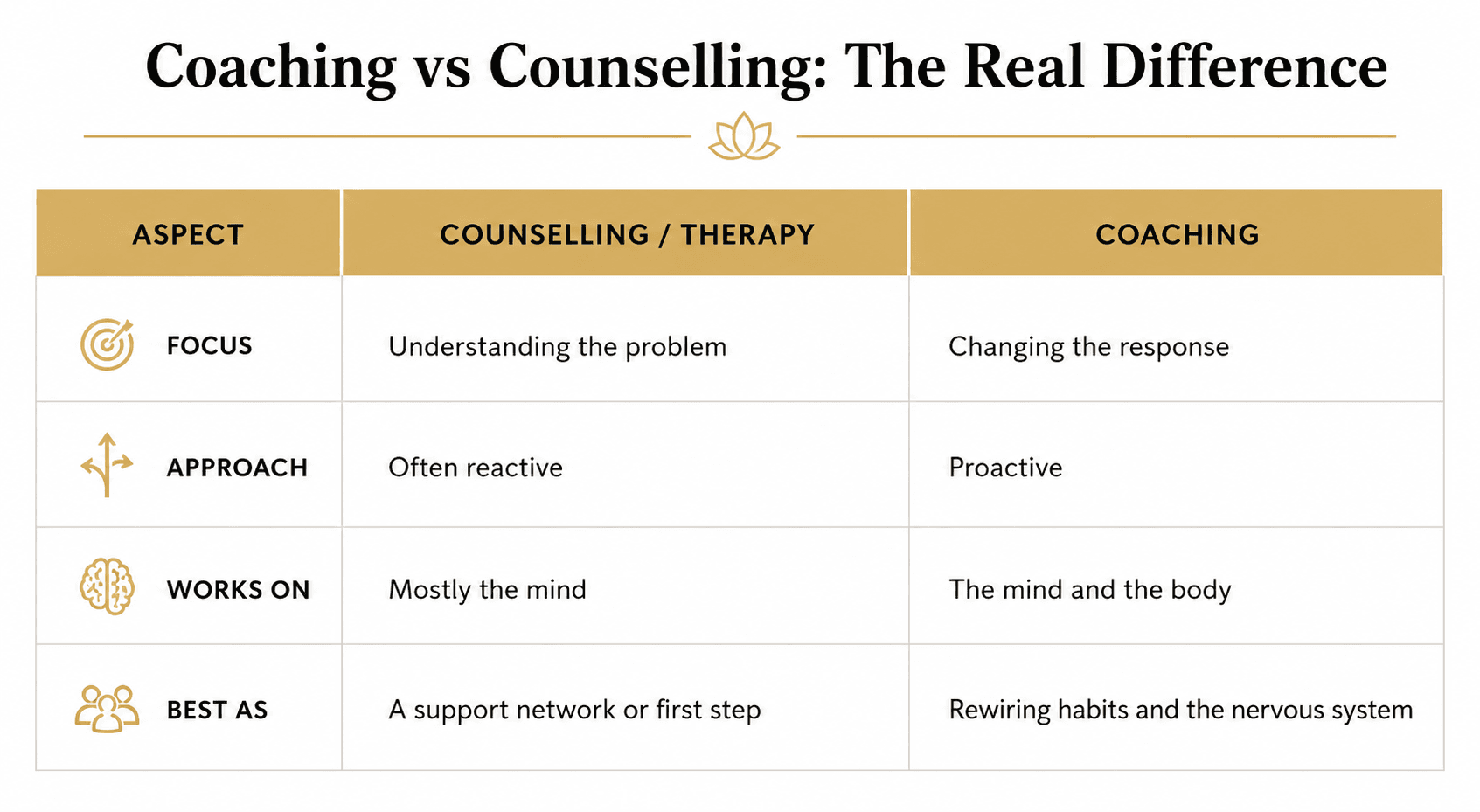
The core split is simple. Counselling tends to be reactive and focused on understanding. Coaching is proactive and focused on change.
One helps you talk about the problem. The other helps you build the habits and nervous system skills so the problem has less grip in the first place.
Neither is wrong, and for some people therapy is the right first step. But if talk therapy has only ever got you so far, that's usually the sign that you need to change what your mind and body are doing, not just understand it.
That's exactly what I help people do at Mind Launch.
It's not a magic pill or a quick fix, but if you don't want to lean on medication, and you don't want to talk about your problems in therapy endlessly, this can get sorted in 3-6 months depending on how much work you're willing to put in. If you're a business owner or professional ready to make a serious change, go to mindlaunch.com.au and apply for coaching.
FAQ
Is coaching better than counselling for anxiety? It depends on what you need. Counselling is great for understanding your anxiety and having support. Coaching is better when you want to actively change your habits and nervous system so anxiety has less grip. If talk therapy has only got you so far, coaching is usually the next step.
Can an anxiety coach replace a therapist? Not always, and they're not the same thing. Therapy and counselling have a clear place, especially as a first step or for clinical needs. Coaching is a proactive, skills-based approach. Some people do one, some do both.
Does anxiety really live in the body? Yes. Anxiety isn't only a mental health problem. It's a fear-based, physical experience, which is why talking about it alone often isn't enough. You have to work with the body, not just the mind.
Do I need medication for anxiety? That's a conversation for you and your doctor, not something to decide from a blog. Medication can take the edge off for some people. The aim of coaching is to give you tools so you're building long-term change, not just managing symptoms.
How long does anxiety coaching take? At Mind Launch, most people see real change in three to six months, depending on how much work they put in. It's not a quick fix, but if you go all in, you can see profound results.
To learn more about the Mind Launch Method, watch this short 10-minute explainer video.